Dungeons & Dragons has traditionally divided magic into three types: arcane magic, divine magic, and psionics. The third has always been something of a red-headed stepchild.
Thursday, April 18, 2019

Tuesday, April 16, 2019
Monster mothers: moon woman
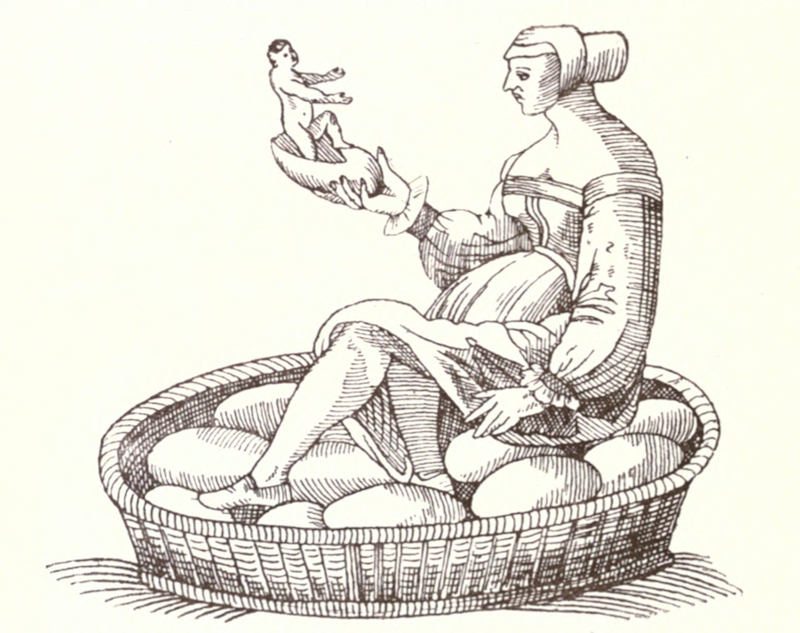
In some medieval bestiaries, a being translated into English as a "moon woman" is described. She is attributed to Herodotus and Aldrovandus, originally under the dubiously Latin name Selenetidae mulieres (shortened to Selenetides in later recounting) and variant spellings thereof. Very little information is provided about her, except a simple description: the moon woman laid and incubated eggs that hatched into giants (sometimes quantified as fifteen times to fifty times larger than men).
She was mentioned in a satire of the often lurid and false accounts of foreign lands given by explorers in the colonial era (such as John Mandeville). Here, she is described as an entire race of women native to the mythical land of "Selenetide." In another account, the moon-women are said to be "mothers of nature"; she is mother to the egg that hatched Helen of Troy, since it fell from the Moon.
The phrase "moon woman" is used to refer to the moon goddess of certain cultural myths, particularly the translated oral histories of First Nations peoples. I suspect this is a more or less literal translation of the original language, although I am sure something might have been lost in translation.
In fairy tales, giantesses appear fairly often as a motif. They appear as both solitary figures and the matrons of whole families of giants. (Some examples are recounted in a collection of Armenian fairy tales collected by A.G. Seklemian.) The moon woman may easily draw upon such traditions. Oddly enough, the moon woman never seems to be described as a giantess herself in the sources I consulted.
Etymology
The word mulierēs is the nominative plural of mulier "woman; wife; (Medieval Latin) adult virgin." The word selenetides is more difficult to discern. I suspect that it is a compound of Selenite ("inhabitant of the Moon") [itself from Selene ("moon") + -ites ("belonging to")] + -idae ("son of") or -ides ("resembling"). I suspect it may be patterned after the word titanides, referring to female titans. Oddly enough, Selenitidae is a family of gastropods.Another possible translation into English would be Selenitess, from Selenite + -ess (feminine suffix).
Additional research links
- http://www.gutenberg.org/files/42508/42508-h/42508-h.htm
- http://es-kiz.ru/the-13-scariest-monsters-from-the-medieval-bestiary/
- https://blogs.scientificamerican.com/running-ponies/curious-and-terrifying-creatures-in-zoology-plus-one-obscure-christmas-gift-idea/
- https://www.atlasobscura.com/articles/the-ravenna-the-manticora-more-11-somewhat-lesser-known-monsters
- https://commons.wikimedia.org/wiki/File:The_Selenetidae_women_giving_birth_to_eggs._Wellcome_L0005356.jpg
- http://www.auswhn.org.au/blog/other-births/
- https://warriorsofmyth.fandom.com/wiki/Moon_Woman
- http://www.maicar.com/GML/Helen.html
- https://www.thereedfoundation.org/rism/chapman/moon-woman.htm
- https://en.wikisource.org/wiki/Myths_and_Legends_of_British_North_America/11
- http://thewayofshawn.blogspot.com/2012/01/mother-of-chaos.html

Wednesday, April 10, 2019
Critique of D&D's schools of magic
Dungeons & Dragons traditionally divides magic into eight "schools." While seemingly well-defined, across editions spells have often changed schools. This reveals that the definitions of the schools are too often unclear and, ultimately, arbitrary.
Saturday, March 30, 2019
Ecology of the unicorn
The unicorn has been represented in a variety of ways in folklore and fiction, so it doesn't have a consistent or orthodox ecology. Unicorns generally fall into one of four archetypes, paralleling the development of the unicorn myth in popular culture. These correspond to the monster types beast, celestial, fey, and fiend.
- As a [beast], the unicorn may be identical to a common rhinocerous or possess at least minor supernatural traits. At the very least, its horn ("alicorn") is a universal antidote to poison. It may or may not be pacified by the presence of a virgin.
- As a [celestial], the unicorn is a messenger of God and a potential paladin's steed. Its powers would focus on fighting evil, as with other angels. It may overlap with the pegasus, having flight in the form of wings or levitation.
- As a [fey], the unicorn is a woodland deity that defends its forest from interlopers.
- As a [fiend]... well, just look at the nightmare.
The standard D&D unicorn straddles between the first three archetypes. It is classified as a [celestial] as of 5e, essentially a forest version of the sphinx, but in the lore is associated with the [fey]. I feel this is bad world building because the line between clerics' and druids' spheres of influence should be fairly clear. Earlier editions of the game devised over a dozen more variants, so this conflation is doubly strange.
A number of unicorn variants have been published in third-party products: Monster Encyclopaedia Volume I introduces the platinum unicorn, Monster Geographica: Forest introduces the savage unicorn, Exotic Encounters: Unicorns introduces the sylvan guardian unicorn, storm unicorn and purifier unicorn, Tome of Beasts introduces the shadhavar, Monsters of Feyland introduces the black unicorn and red unicorn, etc.
A number of unicorn variants have been published in third-party products: Monster Encyclopaedia Volume I introduces the platinum unicorn, Monster Geographica: Forest introduces the savage unicorn, Exotic Encounters: Unicorns introduces the sylvan guardian unicorn, storm unicorn and purifier unicorn, Tome of Beasts introduces the shadhavar, Monsters of Feyland introduces the black unicorn and red unicorn, etc.
 |
| 100% anatomically accurate unicorn |
 |
| ©1998 Jonathan Hunt |
In popular culture
Fantasy fiction ascribes the unicorn with all manner of miraculous traits that they notably lack in combat-focused Dungeons & Dragons. What follows is a small and not remotely exhaustive list:
Early accounts of the unicorn or “monocerous” in medieval bestiaries described it as a vicious beast, since it was based on misunderstood accounts of the rhinocerous. Some accounts added the myth that it could be pacified by a virgin, which hunters exploited to trap it. Inspired by these tales of unicorn entrapment, medieval bestiaries came to associate the unicorn with Jesus Christ and the Virgin Mary. The unicorn acquired connotations of purity, and its horn ("alicorn") was reputed to purify poison. In medieval bestiaries, the alicorn neutralizes poison even after being severed.
Harry Potter depicts the unicorn as essentially an animal with magical properties. Their blood can extend life indefinitely, but such a life is “cursed.”
In Peter S. Beagle's 1968 novel The Last Unicorn, the unicorns are depicted more like the Fair Folk. They are immortal and amoral, with mysterious powers that are largely unexplained. In Holly Black's The Spiderwick Chronicles, unicorns are explicitly listed as a type of fairy.
In Peter S. Beagle's 1968 novel The Last Unicorn, the unicorns are depicted more like the Fair Folk. They are immortal and amoral, with mysterious powers that are largely unexplained. In Holly Black's The Spiderwick Chronicles, unicorns are explicitly listed as a type of fairy.
In Ridley Scott’s Legend, the unicorns guard the light of the universe. Their horns have unexplained magical powers, even after being severed. In the Beastmaster television series, a severed alicorn is used to gut a man then immediately heal him.
Fantasy fiction and games have introduced an evil counterpart to the unicorn, typically styled as a "black unicorn" or a "bicorn." This appears primarily in Japanese media, such as Megami Tensei and Overlord. It is the moral opposite of the unicorn: for example, it rejects virgins.
Other monsters have been referred to as unicorns in popular culture, such as the Arabic mi’raj, Persian karkadann, and Chinese qilin.
Research links
- https://en.wikipedia.org/wiki/Unicorn
- https://tvtropes.org/pmwiki/pmwiki.php/Main/Unicorn
- https://tvtropes.org/pmwiki/pmwiki.php/Main/UnicornsAreSacred
- http://hackslashmaster.blogspot.com/2013/11/on-ecology-of-unicorn.html
- https://web.archive.org/web/20081220010733/http://www.eaudrey.com/myth/unicorns.htm
Gaming links
- https://1d4chan.org/wiki/Unicorn
- https://www.reddit.com/r/DnDBehindTheScreen/comments/38y55z/unicorns/
- http://dailybestiary.tumblr.com/post/72834375415/unicorn
- http://www.terminally-incoherent.com/blog/2013/10/28/my-unicorns-are-different/
- https://nerdarchy.com/dd-unicorn-expanding-the-legendary-creature-through-variety/
- http://themonstersknow.com/unicorn-tactics/
- https://pathfinderwiki.com/wiki/Unicorn
- https://forgottenrealms.fandom.com/wiki/Unicorn
- https://en.wikipedia.org/wiki/Unicorn_(Dungeons_%26_Dragons)
Bicorn links
- https://mythology.wikia.com/wiki/Bicorn
- http://www.occultopedia.com/b/bicorn.htm
- https://megamitensei.fandom.com/wiki/Bicorn
- https://abookofcreatures.com/2017/05/01/bigorne/
- https://hollowtreetales.wordpress.com/2010/08/26/thursday-myths-legends-the-bicorn-and-the-chichevache/
- http://megamitensei.wikia.com/wiki/Bicorn
- http://fategrandorder.wikia.com/wiki/Chichevache
- http://www.occultopedia.com/b/bicorn.htm
- http://overlordmaruyama.wikia.com/wiki/Bicorn
Wednesday, March 27, 2019
New monster's types for 5e
The type mechanic is nonsensical. I ranted about this numerous types. But now I am going to throw caution to the wind and introduce new types to D&D 5e because I can. I care not for how it disrupts the rules as written, because one of the guiding principles of this new edition is that the GM can arbitrate whatever they want to rather than relying on the rules to make the decisions for them.
I would introduce a few new types: biomechanoid, immortal, manifestation, sphinx, and spirit.
The biomechanoid type is adopted from Infernum. Biomechanoids are Giger-esque creatures that straddle the boundaries between constructs and living creatures in the creepiest way possible. In the lower planes, biomechanoids are used instead of conventional machinery and they are fueled by the tears of the damned.
The immortal type is adopted from the immortal origin in D&D 4e. Immortals are... not mortal. It is used for the many corner cases that wouldn't fit into the aberration, celestial, elemental, fey, fiend and undead types, but should be in a comparable type rather than shoehorned into construct or monstrosity.
The manifestation type is adopted from Relics & Rituals: Excalibur. A manifestation is a creature whose physical existence is caused by a powerful emotion, strong desire, etc.
The sphinx type is adopted from the Nefret campaign setting. The logic goes that: if dragon is a type, then so should sphinx. It generally includes creatures with the forequarters of one animal and the hindquarters of another: sphinx, naga, manticore, hippocampus, pegasus, peryton... even lamia and centaur, I suppose.
The spirit type is adopted from a number of sources: Encyclopaedia Divine: Shamans, Relics & Rituals: Excalibur, and OGL reprints thereof. The concept of spirits is universal in world mythology, so I shouldn't need to explain it.
The spirit type is adopted from a number of sources: Encyclopaedia Divine: Shamans, Relics & Rituals: Excalibur, and OGL reprints thereof. The concept of spirits is universal in world mythology, so I shouldn't need to explain it.
Tuesday, March 26, 2019
Ecology of gargoyles
Gargoyles are a standard D&D monster. Their key oddity, however, is that the lore across editions has been unable to agree on their actual nature. Sometimes they are stone statues animated by evil spirits, other times they are living creatures capable of reproduction.
Beast lords and associates
The beast lords are a group of deities from the Stormbringer universe that were copied by Dungeons & Dragons. The beast lords have appeared in official Dungeons & Dragons supplements and a number of third party publications.
Subscribe to:
Posts (Atom)