Showing posts with label giant. Show all posts

Wednesday, August 14, 2019

Giants that aren't physically large?

In Norse mythology, a jötunn was not necessarily gigantic. They could be excessively beautiful or ugly. For that matter, they did not have to be humanoid. Norse mythology includes giants with multiple heads or the forms of freakish or giant animals like Sleipnir, Fenris, and Jormungandr. Other mythologies didn't limit themselves either. Greek giants had weird features like snakes for legs and the heads of lions, among other things. The size of single giants wasn't consistent either: they didn't change their size, it just never seemed to impede them.

I touched upon these topics in previous posts. In this post, I want to imagine some kind of comprehensible taxonomic distinctions for giants that accounts for all these diverse depictions. Groups referred to as "giants" or "titans" in world mythology include the Greek titans and gigantes, the Norse jotnar and vanir, the Hindu asuras, the Persian daevas, the Arabic jinn, and the Irish fomorians and firbholg. Generally, giants in world mythology are distinguished by great stature (literal or metaphorical), a primordial origin, and an enmity with the gods.

So the D&D definition is just needless pigeonholing, as D&D is wont. Instead, as I previously did with trolls, I propose a list of criteria that may be used to define giants. A giant will not necessarily have all the traits on this list, but they should have several of them to avoid excessive debates about what qualifies as a giant.

  1. Great stature. Often literally referring to great (albeit inconsistent) size, but other times referring to incredible beauty or ugliness, or multiple such traits. Anything of great physical size will not necessarily be a mythical giant, even if that is otherwise the literal definition of the word giant.
  2. Chaotic. Often, but not always, acted in opposition to the gods, as with the Norse jotunn, Hindu asuras, Irish fomorians, and Greek gigantes. Where the gods represent order and civilization, the giants/titans represent chaos and disaster. May be composed of or descended from a prior pantheon that was overthrown, even related to the current pantheon.
  3. Primordial. Often the first race to come into existence or be spawned/created by the primordial gods, predating the world itself even. Thus, they are typically considered to have a divine lineage even if they are not otherwise considered gods (the definition of god is fuzzy in myth). For example, the jotuns were the first beings to arise in Norse myth, and the jinn were the first race created by God in Arabic folklore. 
  4. Elemental. An elemental affinity is common too. Giants in fantasy gaming almost always have some kind of association with an elemental environment like the clouds or the mountains. The Norse jotuns come in several varieties including frost giants and fire giants, and the Arabic jinn were created from "smokeless fire" and "scorching wind." Various thunder gods in some Native American cultures may also qualify under this criteria.
  5. Not necessarily humanoid. Often have some humanoid features like the Greek gigantes having snakes for legs or the Norse Hel being literally half-alive and half-corpse, but other times appear in the forms of gigantic animals like the Norse's eight-legged horse Sleipnir, the giant wolf Fenris, the world-encircling serpent Jormungandr, and the giant eagle Hræsvelgr (the Villains Wiki labels them "Beast Jötunn" or beast giants), or wholly monstrous freaks like the Greek Typhon being an amalgamation of monstrous features. (Other monsters like the biblical Behemoth and Leviathan would also qualify under this criterion. Indeed, their names are used as improper nouns and synonymous with giant.) Addendum 9/27/2019: Also note the wechuge from Dane-zaa folklore. 
  6. Intelligent. This is just an addition I made myself to keep from including any and all kaiju under the giant umbrella. Giants are generally intelligent beings, or at least intelligent enough to speak and do various menial tasks on their own initiative. (This is unrelated to the D&D Intelligence score.) So the various other monsters of Greek mythology like Cerberus, Chimera and Hydra are not considered giants despite their size since they aren't intelligent: they're just vicious beasts with great destructive potential.
  7. May (or may not) be dragons. There is a fair amount of conceptual overlap between giants and dragons. In world mythologies, they are both generally primordial beings of chaos that oppose the gods of order. They are generally considered distinct entities... except when they are not. The Greek she-dragons, even though depicted as nymph-dragon-centaurs, are not labeled giantesses. The Greek giant Typhon is not labeled a dragon despite possessing similar dragon features to the she-dragon. The Norse Jormungandr is labeled both a giant and a dragon, born to giant parents in the form of a dragon.

Of course since we are dealing with mythology and myths are notoriously fluid, I doubt these criteria are perfect. I fully acknowledge that, and I believe the real problem is that fantasy gaming tries to impose arbitrary taxonomies on fictitious concepts. However, having multiple criteria to select from should make it easier to justify labeling Hræsvelgr a giant but not all giant eagles: in that case, Hræsvelgr is still a primordial being of chaos whereas the giant eagles are not. Unlike a lot of gaming taxonomies I could name, that distinction does not feel wholly arbitrary. Although this ambiguity problem vanishes if you allow a monster to be labeled as multiple types. So Hræsvelgr would be [giant] type because of his lineage, size, and sky powers, and [beast] because of his form. Hence, beast giants!

Speaking of beast giants, I wonder how they contrast with the beast lords and elder beasts I mentioned in other posts. Would they be distinct, or different titles for the same beings? For example, the Norse Garm is considered the exemplar of canines, yet elsewhere the race of Moongarm's are labeled giants. In the interest of simplicity and reducing confusion, I would happily consider them synonymous.

Additional links

Addendum 10/29/2019


Tuesday, April 16, 2019

Monster mothers: moon woman


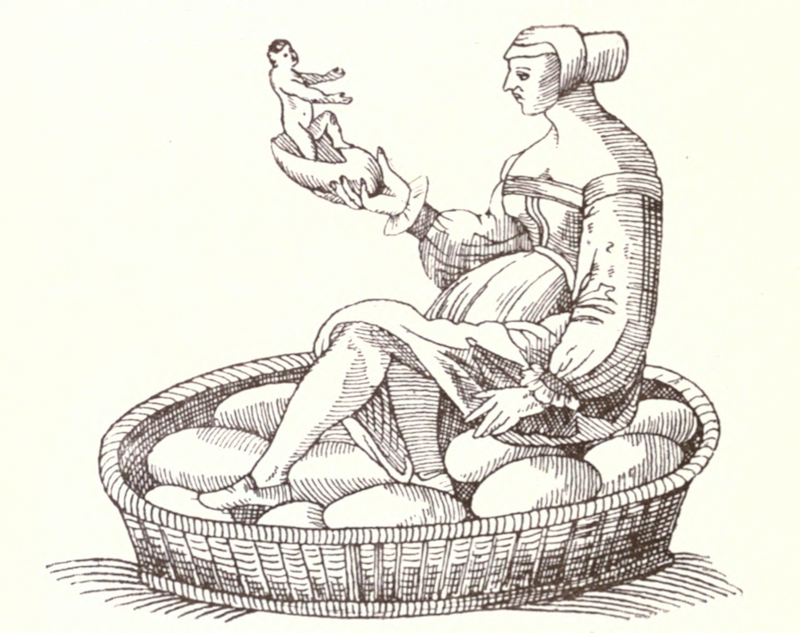
In some medieval bestiaries, a being translated into English as a "moon woman" is described. She is attributed to Herodotus and Aldrovandus, originally under the dubiously Latin name Selenetidae mulieres (shortened to Selenetides in later recounting) and variant spellings thereof. Very little information is provided about her, except a simple description: the moon woman laid and incubated eggs that hatched into giants (sometimes quantified as fifteen times to fifty times larger than men).

She was mentioned in a satire of the often lurid and false accounts of foreign lands given by explorers in the colonial era (such as John Mandeville). Here, she is described as an entire race of women native to the mythical land of "Selenetide." In another account, the moon-women are said to be "mothers of nature"; she is mother to the egg that hatched Helen of Troy, since it fell from the Moon.

The phrase "moon woman" is used to refer to the moon goddess of certain cultural myths, particularly the translated oral histories of First Nations peoples. I suspect this is a more or less literal translation of the original language, although I am sure something might have been lost in translation.

In fairy tales, giantesses appear fairly often as a motif. They appear as both solitary figures and the matrons of whole families of giants. (Some examples are recounted in a collection of Armenian fairy tales collected by A.G. Seklemian.) The moon woman may easily draw upon such traditions. Oddly enough, the moon woman never seems to be described as a giantess herself in the sources I consulted.

Etymology

The word mulierēs is the nominative plural of mulier "woman; wife; (Medieval Latin) adult virgin." The word selenetides is more difficult to discern. I suspect that it is a compound of Selenite ("inhabitant of the Moon") [itself from Selene ("moon") + -ites ("belonging to")] + -idae ("son of") or -ides ("resembling"). I suspect it may be patterned after the word titanides, referring to female titans. Oddly enough, Selenitidae is a family of gastropods.

Another possible translation into English would be Selenitess, from Selenite + -ess (feminine suffix).

Additional research links

Thursday, March 21, 2019

Non-humanoid giants

In mythology, there is typically little or no distinction between giants and giant monsters.

Thursday, December 6, 2018

Jotuns versus trolls

In Norse and Scandinavian mythology we have jotuns and trolls (including their various cognates in the Scandinavian languages). They never coexisted in mythology, with jotuns being Norse and trolls being Scandinavian. This is because of Christianity, which caused the Scandinavians to forget their Norse myths and develop new myths to replace them. The replacement of jotuns with trolls is one such instance of this.

To put it bluntly, trolls are just a later incarnation of the jotuns. They aren't distinct species. Of course, this hasn't stopped modern writers from trying to force them to coexist in the same stories. I too am guilty of this.

Having jotuns and trolls in the same story sounds redundant, doesn't it? When you get right down to it, the only difference is that jotuns are always gigantic whereas trolls may range in size from giants to dwarves (in the dictionary and folkloric sense, not modern fantasy gaming's definition taken from Tolkien). In fact, trolls seem to be closer to more generic conceptions of fairies and nature spirits as compared to other cultural mythologies of Europe (e.g. the "wood nymph with a hollow back" is considered a type of troll). So you could easily argue that jotuns are a subset of trolls, specifically the biggest.

Of course, since we aren't making any pretensions of being accurate (insofar as that ever made sense for myths that weren't consistent in the first place) then maybe we could devise different criteria for distinction? Trudvang Chronicles, for example, maintains the distinction that jotuns are elemental beings whereas trolls are not. However, trolls are commonly considered giants in fantasy gaming. Could this be reconciled?

I think that, mirroring the evolution of Norse mythology into Scandinavian mythology as a result of Christianity, the trolls could be explained as degenerate jotuns that have lost their elemental power and sometimes shrunk in size. One side effect of this is that trolls are photosensitive, often turning to stone under sunlight.

Although it isn't mentioned nowadays, jotuns were originally thought to turn to stone under sunlight. This explains both why they aren't around anymore and why a lot of rock formations resemble faces (in reality, the human brain is simply wired to see faces where none exist). Since trolls are an evolution of the jotuns in folklore, they inherited this weakness.

However, not all trolls myths describe them as photosensitive. Depending on the country of origin, the trolls in stories may be entirely photosensitive, not photosensitive, or photosensitive only sometimes. In fact, aside from the names being cognates there are seemingly no traits that all trolls in all Scandinavian tales share in common.

Of course that's really annoying to us modern folks with our anal-retentive obsessive-compulsive taxonomies, so lets just pretend that for the purposes of our modern stories and games that all trolls have common properties selected from a single list. That list is:
  • Tufted tails
  • Horns (and/or tusks and/or other bony growths)
  • Huge noses (and/or ears and/or other cartilaginous growths)
  • Photosensitive (variable severity ranging from being nocturnal to dying)
  • Turn to stone upon death (and/or entering any comatose state)
  • Like other giants, may have extra limbs and/or heads


Trivia: The "wood nymph with a hollow back" has a number of different names in the Scandinavian languages. 
  • elverpige (elver "an elves" + pige "a girl", "a she-elf")
  • ellepige (elle "an alders" + pige "a girl", "a dryad")
  • huldra ("the fairy")
  • skogsrå (skog "a forest's" + "a fairy", "a dryad")

Friday, November 16, 2018

Ecology of the Cyclops

The cyclops in fantasy gaming is fairly boring. It is just another giant monster that is out to kill you. This is in contrast to their place in Greek mythology, in which they were the allies of Zeus who forged his lightning bolt and helped him overthrow Cronus.

Why are giants distinct from humanoids?

One of the problems encountered by D&D is that it shoves a bunch of monsters from unrelated world mythologies and expects them to play nice. Giants are a perfect example. D&D arbitrarily limits creatures of the giant type to giant humanoids, ignoring the diversity of giants in myth. Furthermore, there isn't an actual distinction between giants and humanoids besides giants being humanoids of at least "large" size in the game rules. Why are they not a humanoid (giant) tag?

In mythology, giants were distinguished by having fairly clear origins. Norse giants were the children of Ymir and ranged from humanoids, to multi-headed humanoids, to giant animals like Fenris, Jormungand and Sleipnir. There wasn't a clear distinction between giants and half-giants, either. Greek giants were the children of Gaia, and similarly included non-humanoid monsters like Typhon and Leon. The Fomorians, who might have been giants but it's difficult to tell, had only vague origins in the wilderness. And so on.

D&D's giants don't have a clear reason to be giants. Even Trudvang has a better distinction by making them into elemental beings leftover from the creation of the world. (Which I am totally using, by the way.) So my idea for giving them a distinct origin, which justifies being their own type, is to treat them as the children of the primordial titans or primal creation or whatever the equivalent is and that is why they have an elemental affiliation too. Humanoids are either their degenerate descendants (a la Warcraft), created from weaker stock or such (e.g. in Sumerian myth humanity was made from the blood of Tiamat).

Thursday, October 4, 2018

No, the plural of sleipnir is not sleipnirs

Paizo does it again: they multiplied Sleipnir into an entire race of eight-legged horses (a la Pegasus in Greek myth). And, of course, they are typed "magical beast" instead of giant (or half-giant?) even though Norse myth did not make a distinction. To add insult to injury (the latter is the injury, not the former, since they falsely claim to be accurate to myth), they applied the English plural suffix -s to make the plural sleipnirs. As you can probably guess, this does not match Old Norse noun declensions at all. As far as my research could determine, Sleipnir was a name (derived from a root for "slip", "slipper", and "slippery", referring to him slipping between the nine realms) and never had a plural form. If I had to guess from other nouns with the same ending, the plural would probably be sleipnar. These sleipnar would then be the descendants of Sleipnir. Speaking of which, Sleipnir never had a surname, but it probably would have been Lokason or Lokison.

Wednesday, October 3, 2018

No, "gegenees" is not the singular form

Pathfinder, like its parent Dungeons & Dragons, likes to take monsters from real world mythology and mutilate them into bestiary entries. As Paizo produced more bestiaries, they quickly started scrapping the bottom of the barrel. Case in point: the gêgeneês (Greek γηγενεης), only briefly mentioned in the myth of the Argonauts, get an entry in Bestiary 5. For the most part they are barely changed from the myth, since there was not much to begin with, except that Paizo gives them tusks, blue skin, and mistakenly uses the plural of their name as the singular and plural forms.

Monday, October 1, 2018

The titans are the parents of the gods

D&D and Pathfinder took the titans from Greek myth and mutilated them until they were unrecognizable. Apparently the titans are the children of the gods. When some titans rebelled for whatever reason, the gods smacked them down; this teaches no moral message that I may discern. Those titans ("empyrean titan" in the 5e MM) who did not rebel were allowed to pillage the land at whim; this teaches that the gods are dicks. Even if killed by a high-level party, their parent will resurrect them. Let's try something else, shall we?

Tuesday, September 4, 2018

Autochthones and Gegenoi

In Greek myth, the giants and other races were spawned by Gaia. There are even a few different names for this: autochthones, gegenees, spartoi13th Age borrows this same concept to explain where its depiction of orcs come from: they spring fully-formed and holding weapons from gashes in the earth, then go forth to destroy civilization as Gaia demands. This concept is really useful because it sidesteps having to worry about things like orc non-combatants and so forth. So I would like to apply that concept to most monsters, at least the humanoids, beastmen and so forth that parties are typically expected to slaughter as a matter of course.

Friday, August 3, 2018

How big were giants anyway? How do half-giants even make sense?

Despite the general obscurity of giants in general, half-giants are a thing in fantasy role-playing, fiction and, to a lesser degree, myth and fairytale. What is often ignored are the physical barriers to their conception, namely the massive size disparity between giants and humans, nymphs or whoever the partner is. By analogy to the mermaid problem, I label this the "giant problem."

Thursday, August 2, 2018

Ecology of the Argusoïd

Argus Pantopes was a hundred-eyed giant from Greek myth. As far I could determine his name translates to "bright/shining all-eyes," which is less a name and more a literal description of his appearance.

Wednesday, May 16, 2018

Renaming true giants

As I mentioned before, words like athach and ettin are synonyms for "giant" that were co-opted by fantasy gaming for completely different meanings. Furthermore, the D&D rules make an arbitrary (and confusing) distinction between "giant" as a monster type and an entry in the monster manual. In earlier editions this was a distinction between "true giants" and "giant kin" (or demigiants?), but later editions simplified the terminology and made it as confusing as it is now.

Monday, November 6, 2017

Multi-headed and -limbed giants

D&D has a bizarre fixation with making every possible anatomical configuration of giants into a distinct race. For example, every two-headed giant is an "ettin," every three-armed giant is an "athach," every three-headed three-armed three-legged giant is an "ubue," every two-headed cyclops is a "biclops," every two-headed troll is a "two-headed troll" (at this point the writer gave up on trying to devise a new name, what a surprise!), etc.

This became so pervasive that Octavirate Presents: Lethal Lexicon Vol 1 parodies the two-headed cyclops by introducing its own "biclops": a cyclops with two eyes, oriented vertically, that give it better depth perception.

Tuesday, August 29, 2017

Giants versus Ogres versus Trolls

In the dictionary, the words giant, ogre and troll are generally synonymous. A giant is "an imaginary or mythical being of human form but superhuman size." An ogre is "a man-eating giant." A troll is "a mythical, cave-dwelling being depicted in folklore as either a giant or a dwarf, typically having a very ugly appearance." If you did a little deeper you will find a surprisingly diverse mythology of giants all around the world. Greek giants have snakes for legs, trolls live under bridges, and so on.

Wednesday, April 26, 2017

Disambiguating taxonomies

D&D has a problem where it uses the same words to refer to monster types as well as specific families within those types. For example, the types dragon, elemental, giant and ooze are divided into "true" and "false" or "kin" families. The distinctions are often minor: "true" dragons have age categories, "true" elementals are amorphous blobs of one or more elements, "true" giants are prettier, and "true" oozes are fast moving. I'm going to devise some alternative terminology that is not ad hoc.