Showing posts with label reptilefolk. Show all posts

Wednesday, November 10, 2021

A glance at "Bestiaries: Creatures of the West and East"

Back in the late 2000s Stephen C. Klauk wrote two bestiaries, Bestiary Malfearous and Bestiary Nefarious, for his decades-old homebrew campaign setting Amberos. In addition to a lot of original monsters created for his setting, it includes a number of substitutes for WotC IP monsters. These include the serpentine aspii in Bestiary Nefarious and the octopoid menten in Bestiary Malfearous, who are described as mortal enemies in their similar quests to remake the world in their own image. Nice.

The two books are also each several hundred pages long. Damn. If only I were so creative and dedicated...

Anyway, the aspii are immortal serpentfolk that use alchemy to transform others into hybrid slaves, and the menten are octopoid aliens from the Realm of Madness that feed on minds (not physical brains, but the energy of the mind itself).

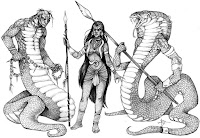
The aspii are similar to other serpentfolk I've covered previously, and share traits with all of them. The true aspii are giant semihumanoid cobras (similar to the illujan lords and anguineum ophiduans) with snakes for arms (similar to the inphidians from the Tome of Horrors series). They create hybrid slaves through both alchemical transmutation and more conventional crossbreeding.

The menten are semihumanoid octopoids that use modified tentacles are arms and legs. They were created by someone else to conquer the material plane by devouring or converting the inhabitants. There are several degrees of slavery, including being mind-wiped, used as raw material to make a horrifying "flesh engine", or taken to the Realm of Madness and transformed into "thrallkin" who form the lowest rank of the true menten species.

Unfortunately, aspii and menten don't seem to be Open Game Content. Not that I mind considering the other substitutes available, but the bit about them having similar goals and therefore being mortal enemies was actually pretty clever and I'm surprised nobody else thought it up. I'm definitely borrowing that bit.

Tuesday, June 22, 2021

Forgotten foes: illujan and ogdoad

Back in 2004 Fiery Dragon released Counter Collection: Gold web enhancements that included open game content replacements for slaad and yuan-ti. The illujans and ogdoads are features of Fiery Dragon's largely unpublished Karathis campaign setting. These monsters were handily archived by the Wayback Machine, so they're not lost on posterity. Unfortunately, no other publishers used these monsters despite their being open game content. Since they're almost two decades old now, I don't see that changing any time soon.

Time for some interesting trivia to justify making this post beyond plugging that link:

  • Illujanka is a great dragon/serpent in Hittite myth that was slain by a storm god.
  • The Ogdoad were primordial deities in Ancient Egyptian myth. They were paired deities of male frogs and female serpents. (For comparison, Pathfinder introduced chaos serpents called proteans.)

Friday, November 15, 2019

We don’t need so many reptilian races

One of many oddities of D&D is that it has a bazillion reptilian races. As with goblinoids and orcs, I think it makes the most sense to treat all these chike/gatorfolk, kobolds, lizardfolk, serpentfolk/naga/ophiduan/inphidian, lernaeati/dorvae/manalishi, troglodytes/xulgath, dinosaurfolk, etc as members of the same monster family. For example, the reptilian races could be distinguished by categories like subrace, caste, size, tribe, degree of anthropomorphism, etc a la Warhammer Fantasy lizardmen.

Way back I briefly recapped the saurian race from Slavelords of Cydonia, which had several castes representing different reptile varieties like gators, chameleons, and turtles. I said back then that it made sense too, but this moment I wanted to add something else.

The reptilian races should be explicitly linked with dragons, dragonborn/dragonkin/dragonspawn, and so forth. In D&D-inspired media, this is already seen to a degree like the “dragonewt” race.

Furthermore, I think this family should (vaguely) include what amphibian races exist. A herptilefolk family? I alluded to this a while back when I discussed the Ogdoad of Ancient Egypt, a paired set of primordial deities in the forms of snakes and frogs. (Which are the parents of basilisks. Patterns are fun!)

In a future post I intend to explain about how I would define dragons based on comparative mythology rather than the idiosyncratic D&D norms.

Tuesday, July 2, 2019

the Ogdoad and Protean

The ogdoads and proteans are exemplars of chaos resembling frogs and snakes, respectively.

Thursday, March 21, 2019

Nagas and water weirds

An interesting coincidence I noticed were some similarities between the d20 monsters nagas and weirds.

The d20 naga are magical human-headed serpentine immortals loosely based on the naga in Vedic myth. They have a number of different variants in different d20 books, including 3pp like Creature Collection, Rokugan, and Monsters of the Mind. I have no idea what their fluff is, but apparently they associate with astrology.

The weirds are a family of generally serpentine elementals whose capabilities have varied widely across the d20 editions. Originally introduced in pre-d20 as the water weird, they were expanded under the d20 era through Monster Manual II, Dragon magazine and Tome of Horrors. The expansions included additional elemental variants and semi-humanoid oracles (playing off the etymology of weird).

Is there a connection between the naga’s astrology and the weird’s weirdness? I think a lot of d20 have a general problem with blandness, so condensing monster families to make a more interesting result always strikes me as a good thing.

I’ll probably post a more detailed ecology in the future.

Thursday, October 4, 2018

Ecology of fire salamanders

Salamanders are the prototypical fire elemental, having been codified by Paracelsus in his writings on elementals. Contrary to the fairly limited depiction they get in D&D, I imagine salamander folks as being quite variable in appearance and lifestyle. Although commonly depicted as being serpentine centaurs, I think they should come in a variety of anatomical configurations including lizard centaurs, draconic centaurs and humanoids.

Tuesday, September 25, 2018

A brief list of OGL serpentfolk

Over the course of my studies I have encountered a variety of serpentfolk in d20 3pp. Here is just a list, by no means exhaustive:
  • Samat (Nyambe: African Adventures)
  • Illujan: Lord, Spawn (Fiery Dragon Counter Collection Gold)
  • Ophiduan: Anguineum, Hominis, Semiferum (The Iconic Bestiary: Classics of Fantasy)
  • Sli'ess (Slavelords of Cydonia)
  • Ssanu (Arcanis)
  • Naga (Rokugan)
  • Serpentfolk, Nagaji, Vishkanya (Pathfinder)
  • Asaatth, High/Low Gorgon, Ophidic Giant, Savant Hydra, Heartclutch devil (Scarred Lands)
  • Bleak Mamba (Lethal Lexicon)
  • Inphidian (Tome of Horrors)
  • Scalefolk (Monster Encyclopaedia)
  • Sevren, Sesheck (Bleeding Edge Adventure #2: Beyond the Towers)
  • Lernaeati (Monsters of Porphyra)
  • Penitents (Slayer’s Guide to Yuan-ti)


Karathis Illujan links
  • http://fierydragon.com/downloads/ccgold_illujan_we.pdf
  • http://www.enworld.org/forum/showthread.php?32348-Karathis-setting
  • http://www.fierydragon.com/
  • http://karathis.2xs.de/

Wednesday, March 14, 2018

Ecology of serpentfolk, part 2: the saurian race

This post will briefly explain the origins of the reptilian humanoids in the fantasy world. The various lizardfolk, serpentfolk, gatorfolk, tortoisefolk, etc are all scions of the ancient saurian race.

Monday, July 24, 2017

Ecology of serpentfolk

Yuan-ti and sarrukh are not open game content, so I will be replacing them with a generic saurian and serpentfolk race.

© Beth Trott

Nomenclature: illujan, inphidian, nagaji, ophidokolasis, ophiduan, reptoid, samat, scalrath, serpentfolk, viskanya, etc

Description: squamous humanoids descended from lost empire, prone to mutation and crossbreeding

Wednesday, June 28, 2017

The art design for naga

D&D Naga are a lot less colorful than their Hindu inspirations (Addendum 7/11/2017: or even the Naga in Creatures of Rokugan). These are my suggestions to make them look (and maybe act) more interesting.
©2012 Kuroi-kisin