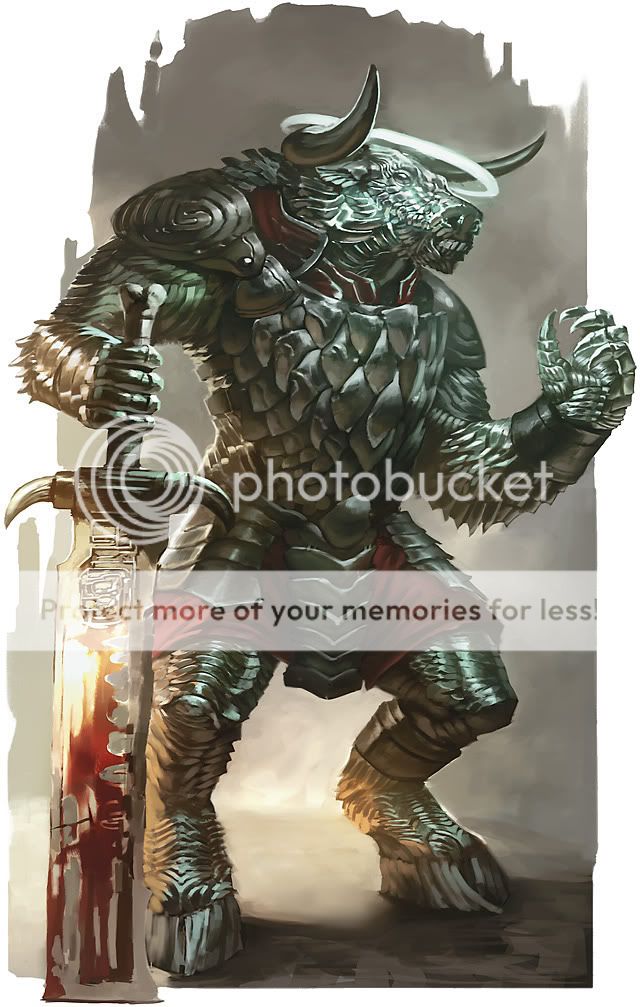
Showing posts with label minotaur. Show all posts

Wednesday, September 2, 2020

Minotaurs and minotrices

So I was reading Masters and Minions Horde Book 2: Maze of the Minotaur when I came across the nonce word "minotrices," which the book called female minotaurs. I found this rather interesting, since while it looks like a Latin word it isn't real Latin and doesn't follow the standard rules for inventing Latin words.

The Latin word for Minotaur is Minotaurus. This is a masculine proper noun for which no feminine inflection exists because the name is a compound of Minos (the historical king of Crete, whose name itself became a royal title) and taurus (a bull), thus meaning "the bull of Minos" or "the king's bull" (and which could be further shortened in English to kingsbull, by analogy to kingsman). The Latin word for a cow is vacca and so the feminine counterpart would logically be the Minovacca rather than, say, the Minotaura. (Compare with my prior post on incubus/incuba and succubus/succuba.)

Yet the nonce word "minotrices" doesn't follow this pattern. The suffix -trices is the plural form of the Latin suffix -trix. This suffix is the feminine form of -tor, which indicates an agent noun (e.g. executor, executrix). Even stranger: the book writes the singular form as "minotrice," which is ungrammatical as -trice is in the ablative case and not the nominative.

Apparently the author of the book misinterpreted the English word Minotaur as a Latin agent noun based on superficial phonetic similarity and went from there. While this may seem nonsensical, you may perhaps contrive a functional meaning by delving further into the etymology of Minos. While in Cretan it means "king," it may descent from a Proto-Indo-European word meaning "ascetic" (although such a reading is debated). So as an agent noun (albeit redundant, unless one is aiming for wordplay), it would mean one who lives ascetically e.g. in caves or mazes.

Or you could just call a female minotaur by "minotauress," a neologism dating back as far as at least 1916.

Friday, June 21, 2019

Minotaurs: sources and ideas

I first started my series on minotaurs a long time ago and my ideas have changed and matured a lot since then. My original posts were pretty rambling in nature. So this post will be where I condense my prior ideas to lay out a concrete path for myself.

There are a number of gaming resources I consulted to devise my picture of minotaurs. These included:
In my conception, minotaurs have several key traits that set them apart:
  • The king’s bull: in real life, the word minotaur translates to “king’s bull.” This is because the curse was evoked by the wicked king Minos the Younger. In a fantasy setting, there should be a reason for this name. So I would like to keep the Minos connection.
  • The starry one: the Minotaur was named Asterion, a name that meant “starry one.” When the Greeks burrowed Etruscan myths, this is probably where the myth of the minotaur came from. Historically, Asterion was a king of Crete and may have been worshiped as the incarnation of a bull god. 
  • Curse of the minotaur: there is a clear distinction between herdfolk (aka furries) and minotaurs. Minotaurs are not a true-breeding race, but a curse that transforms someone into a minotaur. If this curse is broken, then the minotaur transforms back into their race of birth. Herdfolk may be so cursed, but they aren't synonymous.
  • Maze of the minotaur: all minotaurs are doomed to be trapped in a magical maze as part of their curse. This may occur immediately upon contracting the curse, even being the cause, or develop over some period of time.
  • Gulf of azroi: the plane of mazes, all minotaurs' mazes, or more accurately between them. It is the domain of the azroi, abstract entities of order worshiped by minotaurs. The deities worshiped by minotaurs, such as Asterion, Baphomet, etc may be members of this race.
  • Many societies: minotaurs don't have a fixed social structure. They have wicked cultists, noble mariners, tribal peoples, etc. Each maze may very well be its own realm. For example, some herds may be caste-based, such as that in Masters & Minions. Assuming that they aren't confused with herdfolk. Remember, minotaurs are king's bulls cursed with the maze.
  • Many varieties: there are many varieties of minotaur, such as psychic albinotaur and fire-breathing pyrotaur. Not only that, but minotaurs have no fixed or default appearance. A bull-headed man is just as likely as a bull-centaur.
  • Feminine suffix: If anyone needs a feminine form of the word minotaur, then I suggest minotrice, minotress or minotauress as possible examples.
  • The golden minotaur: This is my attempt to tie in the myth of King Minos or Asterion with the fantasy minotaur. The golden minotaurs remnants of an ancient noble race (of herdfolk?) who lived on the island Crete. Their king (Minos and/or Asterion) called down the curse upon them, causing many to degenerate into the other varieties of minotaur through mutation and crossbreeding. Every gorgotaur (really ugly minotaur mutants with hooves for hands) was originally a proud golden minotaur whose curse consumed him.

In the future I hope to continue my series on minotaurs. Next up I'll either be dealing with minotaur societies or mutations.

Thursday, June 13, 2019

What is a gorgotaur?

While skimming books and searching the web I came across the invented word gorgotaur. Etymologically, it is a combination of the Ancient Greek gorgos ("terrible, fierce") and tauros ("bull"); thus, it literally translates as "terrible bull."

It could also be considered a combination with centaur instead, due to mistakenly assuming that taur means "a centaur-like creature" rather than a bull. Interestingly enough, some ancient art of Medusa depicts her as a centauress.

D&D made the weird choice of depicting a toxic iron bull as a "gorgon," despite more closely resembling the mythical catoblepas, so to avoid confusion I will use the unambiguous terms medusa and iron bull instead.

I have seen the word gorgotaur used rarely in a couple examples. In the roleplaying game Mazes & Minotaurs, the gorgotaur is a heavily mutated or primordial minotaur; among other features, it has hooves instead of hands (examples @ grieksegids.nl and clipart.com). In the supplements Encyclopaedia Arcane: Crossbreeding and Monster Geographica Underground, a gorgotaur is a hybrid of minotaur and iron bull. Speaking of hybrids, Book of Templates Deluxe Edition 3.5 introduced a half-iron bull or "demigorgon" template.

The name may be analyzed in other ways besides the three mentioned above. Perhaps a combination of an iron bull and a centaur or bucentaur? Maybe a combination of minotaur, iron bull and (bu)centaur? Maybe a combination of a medusa (i.e. Greek gorgon) and a minotaur?

So that gives us about six varieties to start with: a centauress with snakes for hair who gazes turns onlookers to stone, a grotesque and bestial minotaur, a minotaur with iron hide and toxic breath, a centaur whose lower body is a bull with iron hide and exhales toxic fumes, the preceding with the head of a bull, and a minotaur with a mane of snakes whose gaze turns onlookers to stone.


Tuesday, October 2, 2018

Ecology of the minotaur, part 2: the curse of the maze

In my first post on minotaur ecology lore I promised to fit the diverse portrayals of the minotaur into a cohesive narrative but seemingly gave up halfway through. I will try to fulfill my promise starting in this post. More entries in the series will follow, hopefully...

Thursday, July 26, 2018

Ecology of the minotaur: cults and herds

While many minotaurs are solitary monsters that endless haunt the halls of their accursed mazes or aimlessly rule over them like the beast in Beauty and the Beast or the ogre in Puss in Boots, others form social groups.

Cults of Baphomet

The traditional depiction of minotaur "society" has most commonly been the cult of Baphomet, who fantasy gaming made into the god of minotaurs. In traditional gaming lore, a minotaur or group of closely related minotaurs live in a maze. Since they are an all-male race of cannibals, they reproduce by abducting human females, raping and impregnating them, then eating the poor girls once they no longer serve a purpose. According to 5th edition, minotaurs were originally (and still are being) created by subjecting human cultists to a ritual that made them minotaurs and their descendants inherited this without needing to perform the ritual over every new birth.

As I said before, I do not want to treat the minotaurs as just another race of beastfolk and I feel that a convoluted ecology makes them less magical and drags them further from their mythological roots. So at least in my setting, the cults of Baphomet have to perform the rites whenever they wish to make a minotaur. Because of the profound physical and mental changes, adult initiates will demonstrate a weaker self-preservation instinct compared to those transformed as children or unborn. Although the ritual may hypothetically be performed on women, the orthodox cult seems to only recruit men.

Herds

Herds are a social structure introduced in the third party product Maze of the Minotaur: Masters & Minions, Horde Book 2. There minotaur herds are structured in a manner reminiscent of lion prides and to a lesser degree beehives. The social statuses or castes afford to minotaurs include bull lord (the leader of a herd), minotaur (which I label "brave" to distinguish it), minotrice (female minotaur), minotrice maze mage and tauron (underdeveloped minotaurs used for manual labor). Due to influence from Mazes & Minotaurs, in my setting the castes display various degrees of anthropomorphism and mutation.

Now you may have noticed a contradiction. Masters & Minions gave the minotaurs a naturalistic ecology (at least more so than their disturbing AD&D ecology) and I previously criticized naturalistic ecology as being unnecessary. Well, now I am being a hypocrite and including both cursed minotaurs and a naturalistic ecology in the same setting.

To be honest the herd ecology is not really natural: it is being artificially maintained above and beyond the standard curse. Normally the curse is never so consistently prevalent across generations as to create a self-sustaining race. Alternately, these herdfolk are bovine beastfolk that suffer the curse of the minotaur. Either way it results in the herd society as laid out in Masters & Minions. I would not sweat the details too much.

To be detailed...

  • Tribes (Herdfolk)
  • Minoans (Golden Minotaurs)

Monday, September 11, 2017

Ecology of the minotaur

D&D has a history of taking singular monsters from Greek mythology and turning them into an entire race, which typically act contrary to their mythological origin. D&D also has a history of giving mythological and medieval monsters ecology that loosely mimics real world animals or is needlessly convoluted. I am going to list different varieties of the minotaur that include unique individuals, demigods, divine blessings, curses, playable races, etc and try to fit them all into a cohesive narrative.