Showing posts with label elemental planes. Show all posts

Friday, November 22, 2019

Celestial spheres cosmology, part 2

I previously mentioned the Aristotelian/Dantean cosmology of celestial spheres. The OD&D game took inspiration from the concept when it developed its Mystaraspace cosmology, which would go on to inform the cosmology of Spelljammer. This cosmology was also adopted (or adapted) by retroclones including Blood & TreasureDark Dungeons, and Voidspanners. The specifics and jargon vary between settings, so I'll be using Dark Dungeons as my primary reference here.

The basics

In contrast to the Aristotelian/Dantean cosmology, the celestial spheres are much simplified in this model and take further inspiration from the obsolete scientific theory of ether and modern astronomy; it is unique as far as cosmography models go. The solar system generally behaves much as its does in reality, with the planets orbiting the sun (although some systems may be geocentric or weirder). However, Aristotle's firmament of the fixed stars remains as the sole celestial sphere ("crystal sphere" in D&D jargon). The interplanetary space inside the sphere is an empty "void"; unlike real physics, living creatures have sufficient personal gravity to carry a small supply of air and aren't in any danger of a zero pressure environment. The space and planets within the celestial sphere is mirrored in each of the adjacent inner planes (air, earth, fire, water, ether), which are called "inner planes" because they all exist within the sphere. Outside of the sphere is the luminiferous aether, which is the equivalent of interstellar space. Other celestial spheres containing their own planetary systems exist throughout the luminiferous aether.

Space travel is generally accomplished using spacecraft that are powered by magitech or exploit quirks of the fantasy physics, such as through engines, sails, or other means of propulsion. These vessels are generally modeled after sailing ships, and may even be capable of doubling as sea ships and/or airships.

The OD&D and AD&D games differ greatly when it comes to depicting the outer planes. In the original celestial spheres cosmology, outer planes aka demiplanes were artificial spheres created by the immortals (mortals ascended to divinity) that were anchored to a celestial sphere. In AD&D's Manual of the Planes, the outer planes became independent of the celestial spheres cosmology entirely; when it was retrofitted later as Spelljammer, redundancies were introduced such as the distinction between the "phlogiston" (luminiferous aether) and the deep ethereal plane.

One wonders whether Disney's Treasure Planet was influenced by the game.

Simple variations

Blood & Treasure and Voidspanners put their own spins on this basic model. Both settings are closer to the original Aristotelian Universe in that their universe does not extend beyond the firmament, as opposed to having multiple such spheres emulating real star systems. Both settings diverge when it comes to the nature of the planets, however.

In Voidspanners, the system is heliocentric and the planets may be visited and traded with as per the Dark Dungeons model. Furthermore, the void is full of breathable ether; although prolonged exposure may still be harmful. Overall, the differences from the standard model are minor. As a supplement for Basic Fantasy, no rules for the other planes' geography are included.

In Blood & Treasure, the celestial sphere model is combined with the "orrery" or "solar system" model mentioned in the guides for designing your own planar cosmology. Here the planetary system ("Land of Nod") is geocentric and the transitive, inner and outer planes are presented as concentric spheres and associated planets: the ethereal plane corresponds to the lunar orbit, the astral plane corresponds to the space beyond, the inner planes correspond to the inner planets and the outer planes correspond to the outer planets. Taking a further page from Dante, Hell is located inside the earth and Heaven corresponds to the surface of the firmament.

Since these settings are limited to single systems, it is possible for them to be integrated into the basic model by presenting them simply as quirky spheres floating within the luminiferous aether. IIRC, the D&D canon cosmology uses similar logic to explain the cosmological differences between the different official campaign settings: each celestial sphere may have its own set of planes that aren't necessarily the same as those of other spheres.

On another note, the surface of the celestial sphere is comparable to the outer plane "The Vault of Stars" from 3pp Classic Play: The Book of the Planes. If you want to have adventures on the literal night sky, then I highly recommend using that book (not that I found any alternatives, mind you).

Friday, October 5, 2018

The problem with para- and quasi-elements

The para- and quasi-elements have never been the most logical parts of planar geography. For example, steam is positively charged water and salt is negatively charged water, while ice is air plus water. Mimir.net went a step further and introduced quasi-para-elemental planes. Para-elements as logical mixtures of the elements was explored by Dark Sun. Air plus water made rain, air plus fire made sun, earth plus fire made magma, earth plus water made silt. The quasi-elements would be dramatically different depending on what logic is actually used, since they do not use the same logic.
  • Ice, water and steam make sense as the phases of water.
  • Radiance, fire and ash make sense as the stages of burning. You make sparks, sparks set the combustibles aflame, flame burns the combustibles to ash.
  • Lightning, air and vacuum are not on the same spectrum.
  • Mineral, earth and dust are not on the same spectrum either.
I have seen a few alternate versions of the para- and quasi-planes.

Pathguy suggests:
  • Dust is between Air and Earth. "Negative Earth" is Grime.
  • Steam is between Fire and Water. "Positive Water" is Rainbow.
  • Mist is between Air and Water. "Negative Water" is Ice.

The 3e MotP suggests that the quasi-planes would follow the logic of positive border being dangerously dynamic and active, whereas the negative border would be drained of life and color.
  • Air: the positive border would be storm, the negative vacuum.
  • Earth: the positive border would be earthquake, and the negative would be slag.
  • Fire: the positive border would be firestorm, the negative cinders.
  • Water: the positive would be maelstrom, the negative stagnant.

In general I prefer some variation of the elemental chaos for the actual geography. While the para- and quasi-elementals themselves seem cool, as geography they are just silly. 

The plane of water: The sky of the plane of water is analogous to the plane of mist, rain or vapor. One example of its inhabitants is the niln or "vapor horror" from Tome of Horrors. The land of the plane of water is analogous to the plane of cold or ice, though it is not necessarily cold. The sea of the plane of water is the material plane sea, where the planes merge.

Supplements: Dark Dungeons, Slayers Guide to Elementals, Tome of Horrors Complete, Tome of Horrors 4

Links:
  • http://smileylich.com/dnd/collective/Collective_Q15.html
  • http://expeditiousretreat.blogspot.com/2015/05/enter-elemental-borderlands.html
  • http://www.pathguy.com/inner.html
  • https://mimir.net/mapinfinity/quasi.html
  • http://aveneca.com/cbb/viewtopic.php?t=106
  • https://www.d20pfsrd.com/gamemastering/environment/the-planes/
  • https://campaignwiki.org/wiki/DarkDungeonsSRD/Out_of_This_World#h5o-12
  • http://blogofholding.com/?p=3908
  • http://crushingskulls.blogspot.com/2011/04/quasi-elemental-planes.html

Wednesday, September 26, 2018

Reinventing the Plane of Air

This post collects some random ideas I had in the past for reinventing the plane of air. These are unfinished notes right now, but I hope anyone who reads this can be inspired to have adventures on the plane of air, or as I like to call it: "Cloud Cuckoo Land."

Friday, May 11, 2018

Revising the elemental fauna to be interesting

Let's face it, elementals are boring. When Paracelsus first devised the idea of elementals, he considered them to be analogous to humans and other animals except with elemental affinity and no souls. When Hans Christian Anderson wrote The Little Mermaid, he was referencing Paracelsus when he wrote that mermaids had no souls unless they married a human. This was expanded by later philosophers and fantasy writers, as The Ashgate Encyclopedia of Literary and Cinematic Monsters attests in its entry on elementals. That book states that "Purely amorphous and non-animate representations of elementals are, however, fairly rare" (206), D&D notwithstanding...

Tuesday, January 9, 2018

Life on the elemental planes

I find it easier to keep track of my ideas if I take the time to sit down and write them. As I mentioned in a very old post, I prefer to reimagine the elemental planes as interesting places to visit. They have geography, wildlife and civilizations just like the material plane does.

Wednesday, June 7, 2017

Planar flora and fauna (using the Fire Plane as an example)

The D&D rules are weird and geocentric. If you tried to run a campaign entirely on the elemental plane of fire, you would run into problems with various spells and class features that target specific types because by the rules as written every living thing on the elemental plane of fire should be typed as an elemental. Inspired by Planescape and The Traveler's Guide to the Elemental Plane of Fire, I would suggest a few changes using the elemental plane of fire as an example.

Wednesday, May 10, 2017

Reimagining the elemental planes

The elemental planes are generally presented as infinite featureless expanses of their element. The plane of fire is the sun, water the ocean, earth the compost, and air the sky. These portrayals are quite boring and do nothing to make players want to actually visit these planes. Which makes sense because the elemental planes were originally meant to explain where spells drew material from and not places to visit until the Manual of the Planes fleshed them out. I, on the other hand, would prefer an approach similar to that of The Traveler's Guide to the Elemental Plane of Fire...

Thursday, March 3, 2016

Plain of Burning Coals


The Plain of Burning Coals is a vast, stony plain that serves as the agricultural center of the Plane of Fire. As the name implies, the ground is constantly smoldering, yet even so, many travelers to the plane find that this area presents somewhat fewer dangers and inconveniences than are found elsewhere on the plane, and the region is generally accepted as one of the least hostile to visitors from other planes. Though this region is still blisteringly hot, by human standards, it is much more stable than the roiling Sea of Lava or the erratic volcanoes found elsewhere on the plane, and this stability allows for a much more tranquil lifestyle, where numerous natives work and toil to feed the Efreeti empire in the Elemental Plane of Fire’s closest facsimile to idyllic, pastoral farmland. The dangerous environmental effects of the Plane of Fire are less severe here than elsewhere, and while it is still impossible for humans to live here comfortably without the aid of magic, a number of other races have flourished in this relatively comfortable region. Fire giants, dragons, demons and even some plant life find a home on this vast plain.

The Plain of Burning Coals is the major agrarian center of the Plane of Fire, and contains numerous farming communities, which are responsible for growing nearly all crops produced on the plane. Much of life here revolves around farming and the production and sale of food, from dietary staples such as firewheat to the more exotic magmelons, as well as various forms of livestock. In many ways, this region is the most similar to the material plane, as it is populated primarily by farmers, traders, and the small towns and communities that support them.

In general, life on the Plain of Burning Coals is more peaceful than elsewhere on the plane. The locals here are by and large concerned with their labors, religious devotions, and the problems of their day-to-day lives. The landscape is dominated by sprawling farms, connected by overused and poorly-maintained roads. Interspersed throughout the area are humble towns, ruled over by efreet nobles (who are typically anything but humble). Despite the copious amounts of land, these far-flung fiefdoms are not at all desirable among the efreet, who consider a position on the plains to be effective banishment from the social elite in the City of Brass.

Although the vast majority of the region is farmland, there are a few places of note to be found here. There are quite a few old azer fortresses scattered across the land, and though most are abandoned, rumors abound that the ruins hold great secrets for those intrepid enough to discover them. Besides these fortresses, and the various towns and villages, there are several landmarks that every traveler to the plane should be sure to visit: the Gilded Mosque, the Great Pyre, the Gate of Eternity, and the Everburning Forest. Of course, on the Plane of Fire, even humble farmsteads and simple trading villages can still hold great potential for adventure, especially under the watchful eye of Efreeti lords eager to exercise their authority.

--A Tourist’s Guide to: The Elemental Plane of Fire, Copyright 2013; Authors: Alex Riggs, Joshua Zaback, Rosa Gibbons  

Sea of Fire

Without question, the most dominating feature of the Elemental Plane of Fire is the Sea of Lava, which covers nearly the entire plane. While it is an environment of nearly incomprehensible danger to non-natives, it serves as the main thoroughfare for those who call the fiery world home. Still, much like its watery counterparts, the Sea of Lava presents a number of dangers even to those who can stand its heat and traverse it frequently. There is the risk of getting lost at sea, and stormy weather can prove disastrous. Even creatures that are resistant to the scorching heat of the waves of lava may not be able to swim long enough to reach land, should their boat capsize far from shore. Like any other ocean, the Sea of Lava has a complex system of currents, and on the open ocean, waves can be tens of feet high. The fact that the waves are made of scorching hot molten rock and fire makes it vastly more dangerous than seas made of mere water, however.

Natives to the plane will tell you that, in fact, it is not just one massive ocean, but that there are several distinct seas with distinguishing features; to visitors, however, one region of endless, molten lava seems just like another, and often travelers are too busy trying to survive to appreciate much else about the boiling sea. Once beyond the view of the few islands of civilization that dot the Plane of Fire, there are many dangers that threaten those who would sail on the Sea of Lava, and many details about the sea and its inhabitants are still unknown. Even the greatest of planar travelers have never seen the bottom of the sea’s vast depths, and even those who are comfortable swimming in the molten waves fear the sea’s lurking inhabitants. Fire serpents and worse roam the waves, eager to strike at unwary travelers; few who attempt to swim any distance through the Sea of Lava reach their destination alive.

Despite its many dangers, those who want to travel from one place to another on the Plane of Fire must brave the fiery waves. In order to do so, the efreet have developed ships that can withstand the heat of the lava. These ships are often made of brass or volcanic rock, and are used almost universally for traveling about the plane. Occasionally there are those who think that it would be safer to fly above the sea to get to their destination, rather than floating through it, but the dangers of the skies are not to be underestimated: those who attempt flight will have to be prepared for the terrible firestorms which often rage across the plane, and if a creature can’t endure the heat of the lava sea, such storms spell a similar doom for him. Even if able to withstand the fires, however, travelers who adventure through the sky will find a number of other deadly threats await them: the air is often filled with choking fumes and gasses, and clouds of smoke can make even the most experienced navigator lose his way. And of course, one cannot rule out the chance that a passing dragon or other malicious flying predator might attack. When it comes down to it, most decide to trust the efreet’s ships, which have been (relatively) reliably transporting passengers for countless generations, rather than take on the uncharted dangers of the skies.


Newcomers to the Elemental Plane of Fire will soon find it painfully clear that the efreet do, in fact, strictly control maritime travel and trade. Those who wish to buy or captain a ship across the Sea of Lava can do so only with the permission of an efreet lord (something that is typically very difficult for any non-efreeti to obtain), and with the purchase of an expensive license. Attempting to bypass these laws is punishable by death. Even so, piracy and freebooting are an everyday problem in the Sea of Lava, and maritime marauders constantly threaten trade and stability. Most who travel on the Sea of Lava, however, are merchant vessels transporting heavy cargos of gems or foodstuffs to or from the City of Brass or other civilized places on the plane, or else belong to the efreet navy, which constantly patrols the region with large warships manned with elite efreeti warrior-mages, bent on ensuring the rule of efreeti law.

While the fabled City of Brass is the most prominent location on the Sea of Lava (and, perhaps, the entire plane), there are many other notable areas that travelers often wish to visit. The Pillar of Issum and the Everburning Reef are both major sites of interest in the Sea of Lava, and besides these places there are numerous islands throughout the region where one can find unique and varied creatures and cultures. Chief among these are the five great island cities, which provide a sense of civilization away from the large mainland regions of the rest of plane.

--A Tourist’s Guide to: The Elemental Plane of Fire, Copyright 2013; Authors: Alex Riggs, Joshua Zaback, Rosa Gibbons 

Teeth of Soraak

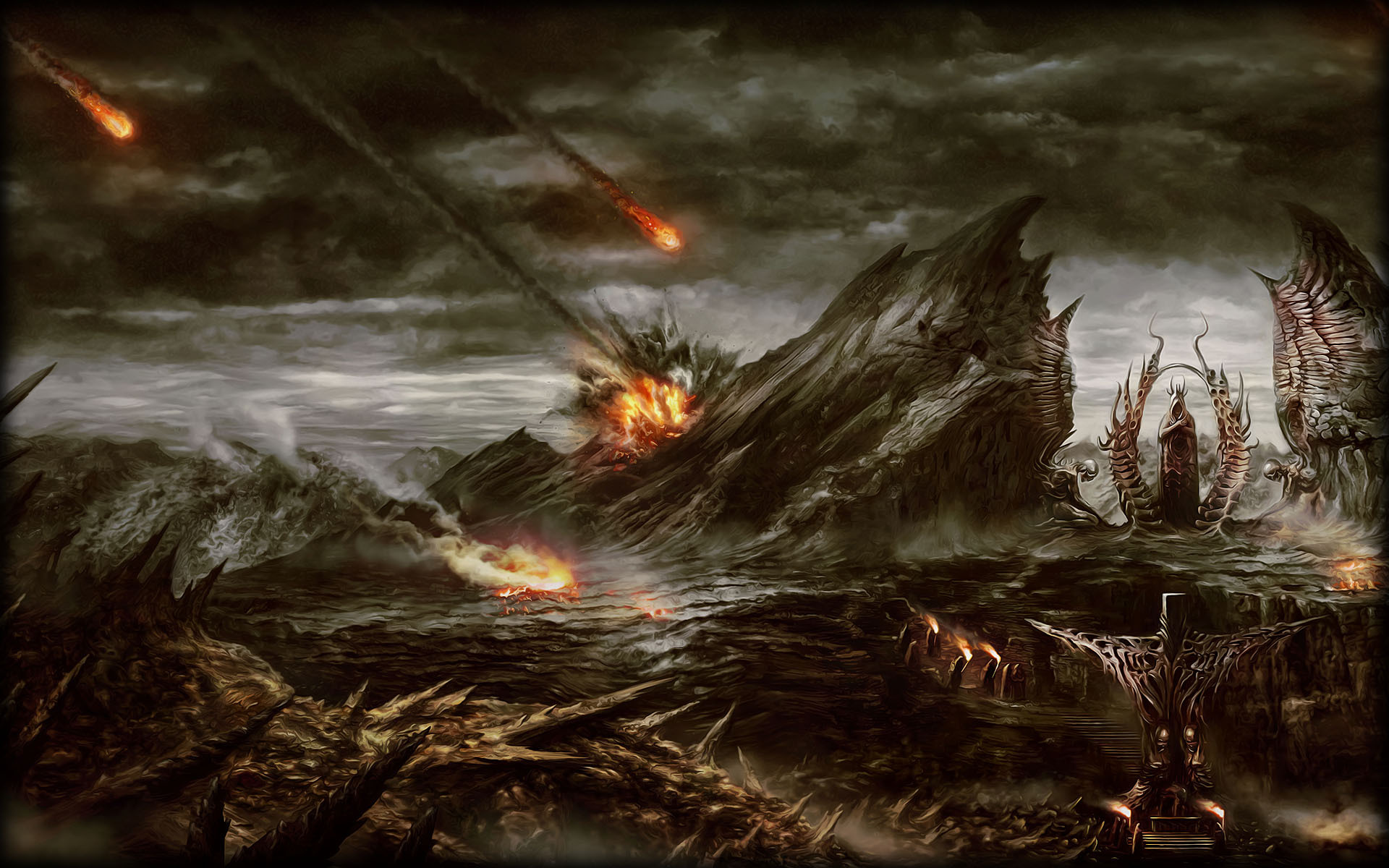
This hellish landscape seems to be drawn from the stuff of nightmares, and many travelers to the plane doubt whether it would really be worse to spend an eternity being punished on the planes of Hell or the Abyss than it would to be forced to live in this region until the end of time. Blackened volcanic rock spires straight out of the vast Sea of Lava, like a twisted dark spine on a burning red body. Towering and broken peaks littered with caves dominate this continent-sized mountain range, and very little survives long here. Often, the peaks of the volcanoes stretch up and out of sight, shrouded in smoky clouds that hang low in the sky. Still, when a volcano erupts, one can make out the burning red glow that marks the height of the peak, even through the dense, ashy clouds. The ground is continuously split by geysers of fire or lava, and rivulets of molten rock crisscross the shattered obsidian landscape. Unsurprisingly, nothing grows in this blasted land. An oppressive air hangs over the whole region, and it is not solely due to the formidable scenery.

Named for the salamander deity Soraak, this volcanic range was once the mighty center of a salamander empire; however, the land was conquered by the efreet centuries ago, and has been under their tyrannical rule ever since. Still, centuries of dominance by the efreet have done little to quiet things down, and the salamanders are constantly rebelling and quarrelling with their masters. So far, the efreet have managed to retain control, but it is not easy, and the next great salamander rebellion always seems to be brewing. This region is far from the center of efreet power, in the City of Brass, and it is only through strong shows of military might and martial law that they have managed to keep the area from slipping out of their hands. It does not help matters much that the salamanders are a fierce and warlike race, and who chafe at the yoke of efreeti rule, and are unlikely to accept their rulership any time soon. Luckily for the efreet, the salamanders are unorganized and hampered by infighting, which has continually proven the weakness in each of their previous rebellions. Now the heart of the salamander resistance lives deep in mountain caves, where the salamander way of life is still strong, and the outlaw salamanders plot how they will free their people from efreeti rule.

Although this region is almost entirely devoid of plant life, it is still one of the most important sources of natural resources for two reasons: precious metals, and precious gems. A wide variety of metals and gems can be mined here in the volcanoes, and the salamanders and efreet fight for control of the largest mines. Another important commodity found in abundance in this region is salamander slaves. The efreet, of course, have no qualms about enslaving unruly rebels, but neither do the clannish salamanders hesitate to capture and enslave those of their brethren who hail from a different mountain or fight under a different flag. In addition to the salamander slaves, there are also more exotic slaves found here, often of a monstrous nature, which are bought and sold for high prices.

Even amid constant war and harshness, some life still flourishes in this region. Many cities of a grand and military nature exist and even thrive here. That said, few visitors are welcomed, and travelers coming to this region should be prepared to fight the elements, the salamanders, the efreet, and possibly all three at once. Those that are able to protect themselves from the region’s warring factions will find that some of the more notable sites in the region include the Cave of Embers, the Frozen Flows, and Ivarshot, the last free salamander city.

--A Tourist’s Guide to: The Elemental Plane of Fire, Copyright 2013; Authors: Alex Riggs, Joshua Zaback, Rosa Gibbons

Ash Wastes

The eternal flames of the Plane of Fire do not require fuel. Still, pockets of matter do drift into the plane through portals, or are brought in as payment or sacrifices to powerful elementals. Whole nations have been consumed by the flames – take a handful of ash floating on the thermal winds, and you hold kings and heroes of old.

All this ash drifts down into the colder reaches, where the Plane of Fire comes close to the Negative Energy Plane. In the depths, there are great deserts of ashes and embers, broken by the occasional pool of still-burning flame or the crumbling remains of scorched stone. The Ash Wastes are all but bereft of elementals, who prefer warmer climes, but the other denizens of the Fire Plane often sift through the ashes for relics.

While this desolate region is far cooler than the rest of the Plane of Fire, it is surprisingly the most lifeless part of the plane, and is truly barren. The region is a massive island (perhaps better described as a continent) which is completely surrounded by the Sea of Magma and totally covered with a thick blanket of grey ash. Absolutely nothing grows here, and, with very few exceptions, nothing lives here – though it has numerous non-living residents.

In many ways, this is the least hospitable part of the Plane of Fire. The landscape is bleak, consisting solely of endless dunes of grey ash. Except for the very occasional glimpse of a ruined azer stronghold, these ash dunes are all there is to see in any direction. Walking through the Ash Desert can be extremely tiring over long distances, as the ash shifts softly underfoot, and feet sink further into the dusty mire with each step. The air is also filled with ash, which is gathered into great swirling clouds by the constant winds which sweep across the region. These ashy clouds are incredibly dangerous, filling the lungs of those caught in them with silky soot, which quickly leads to death by suffocation for those who are ill-prepared. The lack of life also means that travelers to the region must bring their own food and water with them, increasing the difficulty of any extended trips. Compounding the issue, there are few, if any, shelters or outposts within the Ash Desert, and if something goes wrong during an expedition, stranded explorers will have no one to turn to for help or extra supplies.


It is a common belief amongst the residents of the Plane of Fire that the Ash Desert’s cold temperature (by the Plane of Fire’s standards, at least) and lack of life are the result of a lingering magic from an ancient cataclysm, but many scholars dismiss the notion, proclaiming that the region is naturally cooler than the rest of the plane, and that this coolness allows ash present in the air throughout the plane, to settle here, eventually leading to the buildup of great dunes. Natives of the plane generally dislike spending any time in the Ash Desert, both because it is uncomfortably cold for them, and because of the various rumors about how the region is cursed.

For all of these reasons, the Ash Desert is home primarily to those without the breath of life within them. The region is home to large quantities of undead, especially ghosts and specters, and any creature that dies in the region is very likely to rise as a ghost and join their number. The region is also home to another sort of lifeless inhabitant: golems and other wondrous constructs left behind by the ancient azer empire, whose capital once stood in the center of these ashen dunes. Some of these beings lie inactive in forgotten ruins, waiting for some trigger to wake them. Others are quite active, whether standing guard in the long-abandoned halls of their masters, or walking the dunes aimlessly, attempting to carry out tasks issued eons ago.

Despite the severe conditions and the many dangers, there are a few who find reason to brave the Ash Desert. Some of these are fugitives from the empire, doomed to certain death, who decide that their best chance at survival is to try hiding out in the deserted desert. Others are adventurers, seeking to make their fortune by plundering the remains of some undiscovered azer ruin. A handful have succeeded in this, but most who enter the Ash Desert never return. Still, the tales of the great treasures and secrets of the azer empire lying buried in the desert, just waiting to be picked up, entice many. And it is not merely rumor; the azer were a strong and wealthy people before their empire was destroyed, and their scorched and shattered halls remain in broken shambles, still lined with the treasure of kings and relics of an age long gone. A few intrepid travelers come to the Ash Desert, tempted not by the chance to collect gold, but by the opportunity to unravel some of the mysteries of the region. No one quite understands the reason for the region’s colder temperature or increased number of undead creatures, and a mage who could discover the secret of the Ash Desert may be able to find a way to use it for his own benefit. The region also has a few places of note, for those daring enough to reach them, which are also shrouded in mystery: the Pile of Skulls, the Bowl of Smoke, and the ruins of Harshkand’s Vault.

--Classic Play - The Book of the Planes copyright 2004, Mongoose Publishing Ltd.

--A Tourist’s Guide to: The Elemental Plane of Fire, Copyright 2013; Authors: Alex Riggs, Joshua Zaback, Rosa Gibbons