Showing posts with label great wheel. Show all posts

Friday, November 17, 2023

Missing images are a problem! Plus, some images of interstitial planes

Some of the images from my old posts, such as this one, have succumbed to link rot. I was so stupid to not include the original image in my blogger gallery.

I'm not gonna go back and edit the old post. So here's some backups and substitutes! 

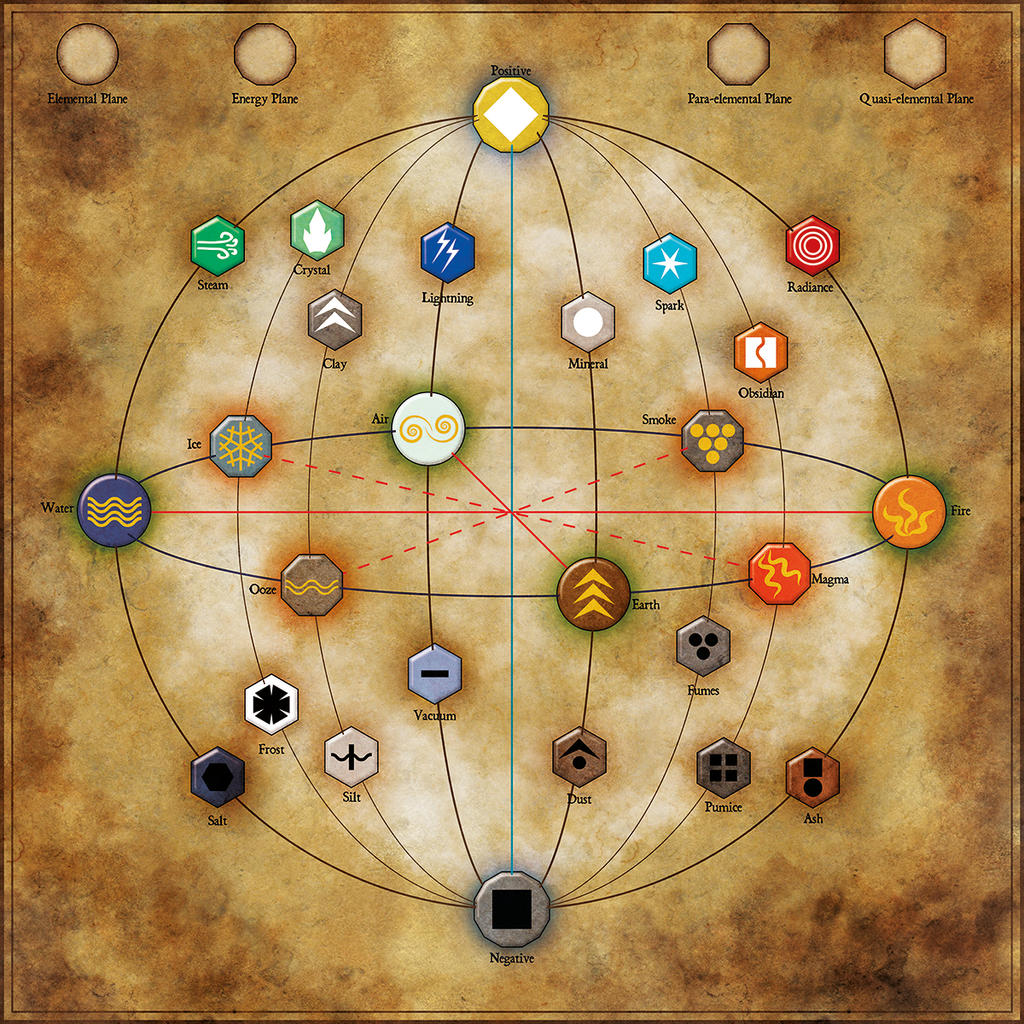
Great Wheel cosmology with elemental para- and quasi-planes

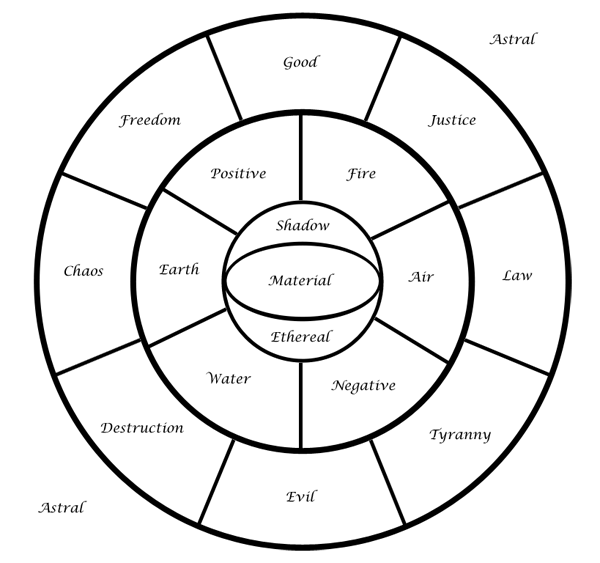
Great Wheel cosmology with elemental chaos

Anethemalon Planes of Existence

Elemental Planes by Sapiento

The Cordant Planes

Pathfinder's Great Beyond

A simple cosmogram

Hope you enjoyed!

Thursday, November 21, 2019

Variations of the great wheel

I haven't posted a planar post in a while so I thought I should get on that.

The "wheel" or "great wheel" cosmology is the default cosmology for the D&D status quo. Originally presented in the Manual of the Planes, it has since received a bunch of different variations. Years ago I tried my hand at reinventing the wheel (pun intended), but I don't recall ever giving a comparison of this cosmology with its several variations. So here we go!

Canonical

Below are the two generally accepted versions of the Great Wheel. The Great Wheel has generally remained the same across the various editions in which it appeared, with only minor changes. The most obvious between 2e and 5e would be the condensing of the lesser elemental planes into the elemental chaos and the addition of the shadowfell and feywild to the inner planes.
Great Wheel circa 2e
Great Wheel circa 5e

The Great Wheel is also called the Planescape cosmology. The prime material plane also has crystal spheres, but those are another can of worms also called the Spelljammer cosmology. When the two are used in tandem, the fandom jargon for the setting is "Planejammer."

Apocrypha

Plenty of GMs have adopted the Great Wheel wholesale with little or no change, such as Anethemalon.
Anethemalon Planes of Existence

The Planescape fans have since added tons of other planes to the wheel. These additions include extra elemental planes, extra outer planes, and extra transitive planes.
Elemental Planes by Sapiento
More inclusive Outlands

Other wheels

Since the Great Wheel isn't OGL, third-party publishers have resorted to creating their own wheels if necessary. For example, both Mongoose's Classic Play: The Book of the Planes and Paizo's Pathfinder present simplified wheels in which the outer planes have been reduced to nine (one for each alignment). Mongoose simply called this the "wheel" cosmology; Paizo called theirs the "Great Beyond."
A generic wheel cosmogram
The Great Beyond

Personally, I prefer simplified cosmologies like the omniverse or world axis because I think all the extra paraplanes and quasiplanes get silly and redundant after a while. But that's for other posts.

Thursday, May 17, 2018

Revising the great wheel: exemplars

The problem with the exemplars in Pathfinder is that there are 1) too many of them, and 2) they generally lack signature motifs. Here I aim to fix that:

Pathfinder uses the Nine outer planes (wheel model), which I leave unchanged for this exercise. Although even then I feel it is too many.

The exemplars of the upper planes are the goodly celestials also called angels. (Angels are not a specific race anymore.)
  • Heaven (LG): archons, which appear as the traditional winged humanoids of Christian art.
  • Nirvana (NG): agathions, which appear as animal-headed humanoids.
  • Elysium (CG): azatas, which appear as celestial fairies and toga-clad giants.
The exemplars of the middle or moderate planes lack a unifying name. (Go figure, they play second fiddle to good and evil anyhow. Stupid D&D baggage.)
  • Utopia (LN): inevitables, which appear as fantasy robots.
  • Purgatory (TN): aeons, which appear as amorphous clouds with limbs.
  • Limbo (CN): proteans, which appear as serpentine things.
The exemplars of the lower planes are called fiends. They’re instantly recognizable.
  • Hell (LE): devils, which appear as angelic humanoids with only slight horns or other surreal features to reveal their nature.
  • Abaddon (NE): divs, which appear as emaciated and rotting demonic undead. (“Daemon” is too similar to “demon.” Stupid baggage.)
  • Abyss (CE): demons, which appear as chimerical monsters out of the Ars Goetia.

Monday, February 27, 2017

An alternative great wheel

As a temporary break from my planar musings for 13th Age, I have decided to take a crack at building an alternative cosmology for 5th edition. The cosmology in the DM's guide is a bit more complicated than it needs to be in order to please Planescape partisans. I do not wish to insult that setting, but I think that many of the planes suffer from either being too hostile for adventuring or too similar to other planes. This post will explain where my cosmology departs from the canonical cosmology.

Thursday, December 15, 2016

Building the great wheel

13th Age doesn't include information relating to planar adventures by default. It's easy enough to refer to other OGL sources for further information, but for my blog I will be putting my own spin on the planes that I hope would be in line with the design goals of 13th Age.

Friday, December 9, 2016

Rebuilding the great wheel

I feel that now is a good time to re-examine the planes from a holistic perspective. What is their purpose? What role do they serve in an ongoing campaign? Are they interesting places to visit? What would it take to run planar adventures starting from level one? Could the great wheel benefit from some streamlining?